The view from Tower Hill
On climbing the south shore’s great dune barefoot, and the long, strange quiet at the top before you run all the way down.
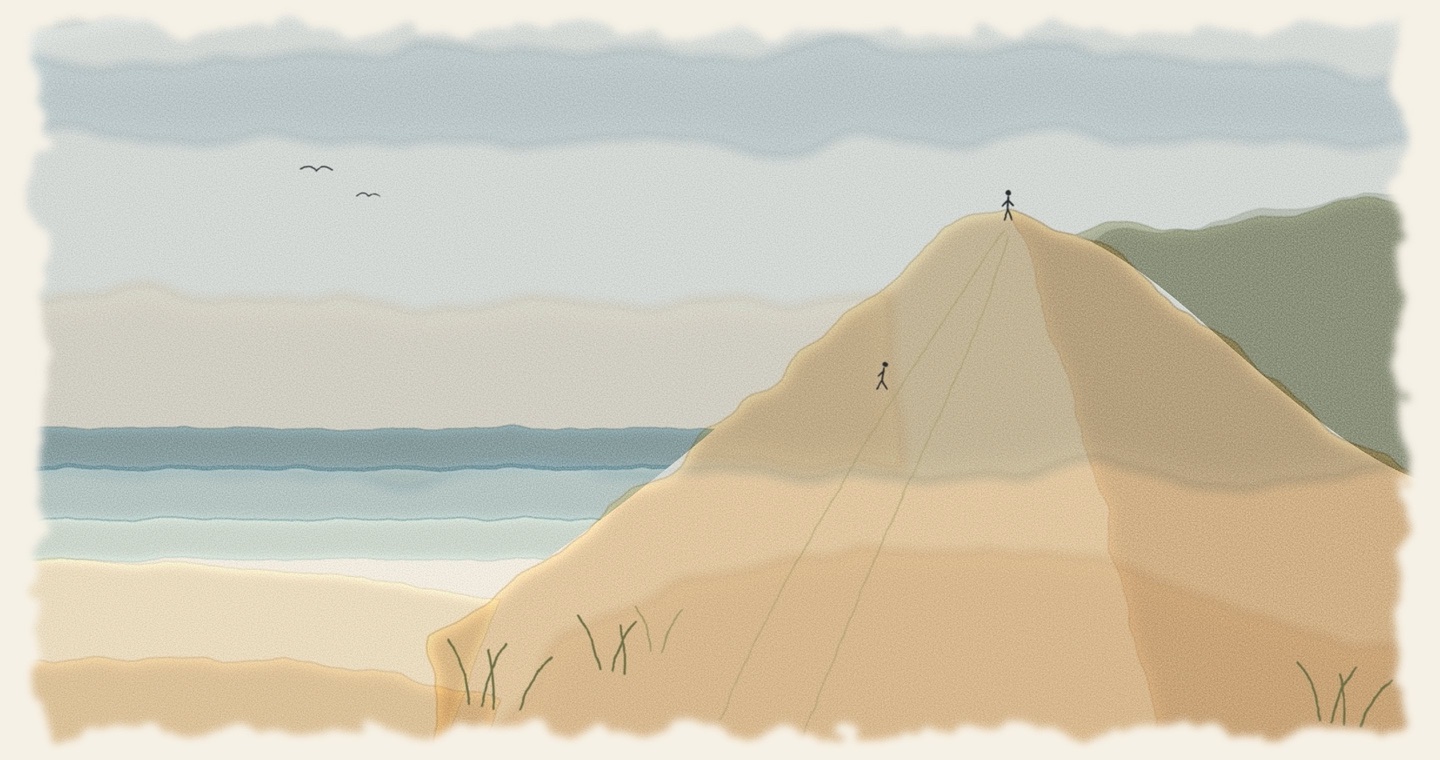
We take our shoes off at the bottom, which is the first decision and the only easy one. It is a weekday in September, late in the morning, and the sand on the face of Tower Hill has dried in the sun but not yet taken on the heat that makes July climbers hop from foot to foot. Above us the dune goes up at the angle sand settles on when nobody interferes: steep enough that you lean into it, not so steep that it lets go. At the top, small against the sky, somebody is standing still.
How high it is depends on whom you ask. The state puts the dunes here at two hundred and sixty feet above the lake; other measurers, less generous, say two hundred and forty.1 The dune takes no position. It is a pile of sand in slow motion, and its height is an argument between the wind and the grass, reopened every year.
The first twenty steps feel like progress. Then the sand begins to give back what you take from it. Each step up slides a third of the way down again, and the climb turns into a negotiation — short steps, weight forward, hands on the slope where it steepens. Children go up on all fours, which is the correct technique. Adults resist it for about a hundred feet.
Halfway up, it is worth stopping, if only to have a reason. Turn and the beach has already shrunk below you to a strip, the umbrellas to coins, and the lake has started to do what it does from any height, which is to go on much farther than seemed possible from the water’s edge. Your own footprints come up the slope behind you in a line that already looks older than it is, their edges softening as the dry sand slumps into them. Nothing on a dune stays sharp for long. That, it turns out, is the subject.
In 1896 a graduate student named Henry Chandler Cowles got off a train at Dune Park, Indiana, on the lake’s southern shore, and looked at the sand. He had come to the University of Chicago the year before to study geology — Ice Age landforms, fossil plants — but he had been reading a Danish botanist, Eugenius Warming, on the plant communities of the dunes along Denmark’s coast. Cowles had admired the book enough to learn Danish so he could read it before anyone translated it. Now he had a coast of his own.
What he noticed, walking inland from the water, was that he was also walking forward in time. At the lake’s edge there was bare sand, which nothing holds. A little way back, the first grass. Behind the grass, a scatter of cottonwoods; behind those, pines and black oaks on older, darker ground; and in the sheltered hollows farthest from the wind, beech and sugar maple. Each band of plants had made the ground ready for the next. Distance from the shore stood in for years.
He published the argument in 1899, in four installments of the Botanical Gazette, under a title only a dissertation committee could love: “The Ecological Relations of the Vegetation on the Sand Dunes of Lake Michigan.” It took in the Michigan shore as well as Indiana’s. It gave the young science of ecology one of its founding ideas — succession, the way one community of plants replaces another — and versions of his dune sequence still appear in nearly every ecology textbook.2 Cowles stayed on at Chicago in one of the first ecology professorships in the country, and in 1915 he and his students helped found the Ecological Society of America. It is, among other things, a Chicago idea: worked out at a university on the South Side, about a lake it shares with this one.
And you can climb it. That is the private pleasure of Tower Hill for anyone who has read a little Cowles. The walk from the water’s edge up and over the dune is his sequence, compressed and tipped on its end.
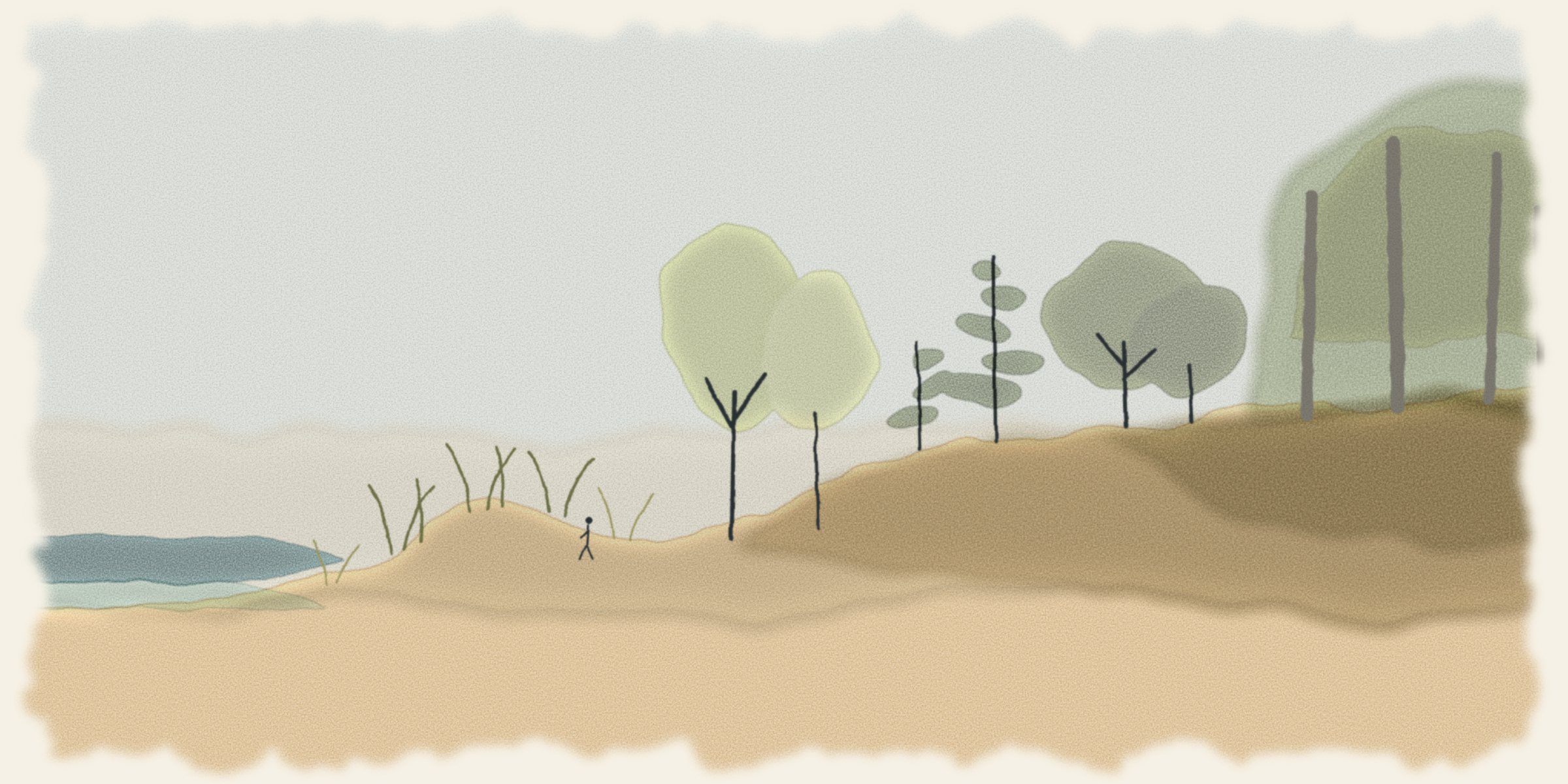
The first plant you meet is marram grass, the long pale blades that lean away from the wind at the foot of the dune. Marram is the dune-builder. It doesn’t merely survive being buried by blowing sand; it thrives on it, sending new growth up through each season’s burial, while underneath it runs a net of stems and roots that can spread twenty feet in every direction.3 A dune with marram on it is a dune with stitches. Step on the grass and you pull them out.
Out on the open sand, in the right year, there may be Pitcher’s thistle: a plant with woolly, silver-white leaves that grows on the dunes and beach ridges of Lakes Michigan, Huron and Superior and nowhere else. It spends five to eight years as a low rosette, flowers once, sets seed and dies. It has been federally listed as threatened since 1988.4 It is easy to walk past, which is most of its trouble. Leave it where it is.
Higher up come the cottonwoods, the trees that tolerate burial best, standing in the sand like people waiting for a bus. Then, over the crest and down the back of the dune, the oaks, and in the damp hollows farther in, the first beeches, pale-barked, their leaves the color of weak tea by October. In summer the air under those trees can be ten degrees cooler than the open slope you have just climbed.3 Cowles would have had an explanation for that, too.
And then the top, and the quiet.
It is not silence. The wind is going, somebody below is shouting to somebody else, and the lake keeps up its low, continuous noise. But people who reach the top of Tower Hill tend to stop talking. Partly it is breath. Partly it is that the effort ends all at once, and the body, which has spent ten minutes working against sand that wanted to go the other way, suddenly has nothing to do. You sit down because it is the obvious thing to do. Nobody tells you to.
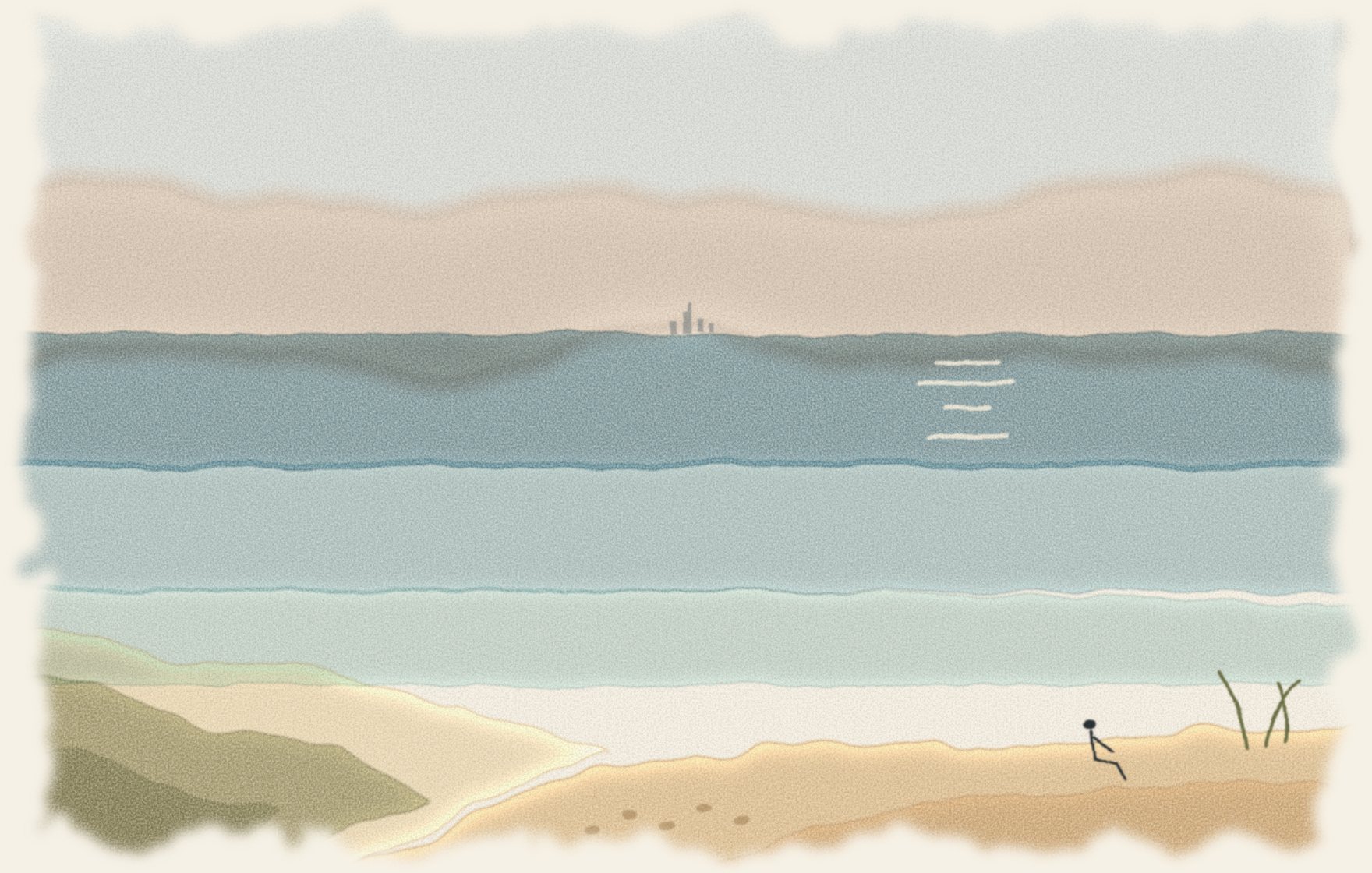
From two hundred and fifty feet up, the horizon is almost twenty miles out.5 The lake fills most of what you can see: green in close, then blue, then a color between blue and grey that is mostly distance. On a clear day, some fifty miles away and almost due west, there are the tops of towers — Chicago, or the upper part of it, standing on the rim of the water like a row of pins. The rest of the city is below the curve of the earth. In spring, when the lake is still cold and the air above it has warmed, the atmosphere can bend the light enough to lift more of the skyline into view, sometimes upside down; photographers have caught it from this dune and from Grand Mere, a dozen miles north.6 On most days you have to know where to look, and the knowing is part of it.
Then turn around, because the view inland is the one people forget. From up here Cowles’s sequence lies flat like a map. The bare face you came up drops away in front of you to the beach; behind you the sand gives way within a few hundred feet to a tangle of low oak, and beyond that the dunes go on in rolling, wooded ridges, one behind another, each older than the last, until they flatten into farmland. You can see the line where the wind stops winning. Somewhere back there, in the hollows you can’t see into, the beeches are growing slowly on ground that was open sand a few thousand years ago. It is the whole of the argument in one look, and it takes about as long to see as it did to read about it.
Look south and there is a nearer landmark: the tall, waisted cooling tower of the power plant at Michigan City, Indiana, which people often take for a nuclear reactor. It isn’t — it is a coal and gas plant, and Indiana has no nuclear power. The tower stands on the site of the Hoosier Slide, a dune that was once the most famous natural landmark in the state. Generations of day-trippers came out on the South Shore Line to climb it and slide down, exactly as people do here. All the while it was being dug away for glassmaking sand, and by 1925 there was nothing left of it. The utility bought the level ground.7 The plant is due to close. The dune is not coming back.
We think about the Hoosier Slide more than is probably healthy, sitting up here. It is the counterfactual for this dune — what Tower Hill might have become if a Three Oaks merchant named Edward K. Warren, who had made a fortune out of turkey quills, had not started buying up duneland in the early years of the last century with the idea of keeping it. The land he set aside became the heart of Warren Dunes State Park in 1930.8 That is the whole difference between the two dunes. Somebody decided.
Running down is the part everyone remembers, and it is less a decision you make than one the dune makes for you. The first three steps are a walk. By the fifth your legs are moving faster than you would choose, your heels are plunging into the sand up to the ankle, and each landing throws you forward into the next. You can’t stop, only slow a little by leaning back. People laugh on the way down who did not laugh once on the way up. At the bottom your calves shake, your feet are full of sand, and you would, if asked, do it again immediately.
That is the whole difference between the two dunes. Somebody decided.
This is one of the few places on the coast where running down a dune is the right thing to do. Tower Hill’s open face is bare sand already, moving under its own weight, and the park lets people pick their own way up it and come down however they like, on foot or on a board.9 Most dune on this shore is not like that. The foredunes behind the beaches, the grassy slopes above the cottages, the low ridges in the parks up the coast: those are held together by marram, and the grass is easy to kill and slow to come back. Where there are marked paths, keep to them. Where there aren’t, keep to bare sand and off the grass. The rule is simpler than it sounds.
Cowles did not think succession ever arrived anywhere. Disturbance and a changing climate, he recognized, would keep any community from settling for good; the beech woods at the end of his sequence were not a finish line, only its slowest part.10 Standing at the foot of Tower Hill in the afternoon, looking back up at the tracks we made, it is easy to see what he meant. The wind has already started on them. By evening they will be gone, and the dune will be the same height, give or take, that the argument between the grass and the wind allows.
We put our shoes back on. There will be sand in them for a week.
Notes and sources
- Michigan DNR, Warren Dunes State Park (“rising 260 feet above the lake”); other published figures for Tower Hill run from 236 to 240 feet.
- NPS, Henry Chandler Cowles; “A Walk through Time,” International Journal of Plant Sciences 186:3 (2025); H. C. Cowles, Botanical Gazette 27 (1899), nos. 2–5.
- NPS, Indiana Dunes National Park, Plant Succession.
- U.S. Fish & Wildlife Service, Pitcher’s thistle.
- ABC57, “Skyline Skepticism: The Lake Michigan Mirage.”
- PBS NOVA, “The perfectly scientific explanation for why Chicago appeared upside down in Michigan”; ABC57, “Mirage of Chicago skyline seen from Michigan shoreline” (2015).
- The Times of Northwest Indiana, “Michigan City Cooling Tower”; and on the plant’s planned decommissioning, “Lasers on the Dunes.”
- Michigan Historical Marker, Warren Woods State Park; Warren Dunes State Park.
- America’s State Parks: Warren Dunes; Visit Southwest Michigan, Warren Dunes State Park.
- NPS, Henry Chandler Cowles.
Where we stay.
We write most of these notes from a house we keep in New Buffalo, about twenty minutes down the shore from Tower Hill. It is open to guests for part of each year.
See the house